
You’ve probably experienced it before.
Halfway through a ride, your shorter riding buddies still look fresh.
Meanwhile, your legs are burning.
Your knees feel tight.
Your lower back is starting to complain.
And every time the trail gets rough, standing feels more like a workout than a riding technique.
At first, most tall riders blame fitness.
Maybe they need stronger legs.
Maybe they’re out of shape.
Maybe they’re simply getting older.
But what if the problem isn’t your fitness at all?
What if the real issue is that your motorcycle doesn’t fit your body as well as you think it does?
For many riders over 6 feet (183cm), fatigue during standing isn’t caused by a lack of strength. It’s caused by ergonomics—and one of the biggest contributors is footpeg position.
Standing Should Feel Natural—Not Like a Squat Exercise
Watch professional motocross, enduro, or hard enduro riders.
They spend a huge portion of the ride standing.
If you’ve ever watched professional motocross racing, you’ve probably noticed that elite riders spend far more time standing than most recreational riders. There are several reasons for this, ranging from suspension performance to rider control and balance.
Related: Why MXGP Riders Spend So Much Time Standing
Yet they don’t look exhausted.
They look relaxed.
Fluid.
Efficient.
That’s because proper standing posture isn’t supposed to feel like holding a squat at the gym.
A good standing position allows the rider to:
- Absorb impacts through the legs
- Move freely around the motorcycle
- Shift weight quickly
- Maintain balance with minimal effort
The motorcycle works with the rider instead of fighting against them.
But when the riding position is too cramped, everything changes.
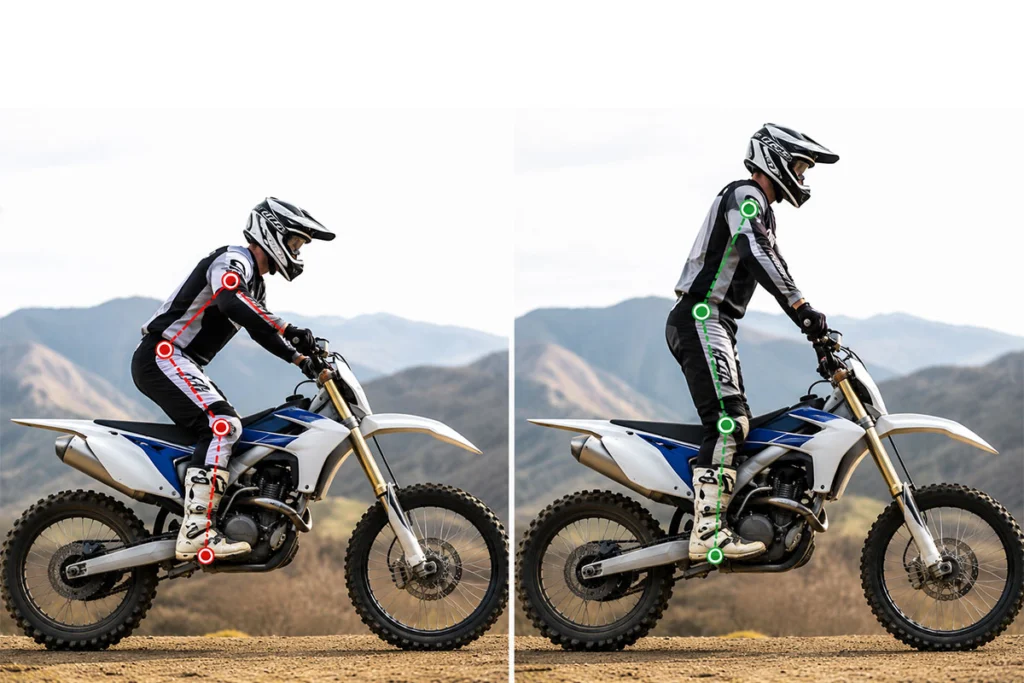
Why Tall Riders Often Feel Cramped on Stock Bikes
Most dirt bikes are designed around an “average” rider.
That makes sense from a manufacturing perspective.
The problem is that many riders aren’t average.
A rider who is 165cm tall and a rider who is 190cm tall experience the same motorcycle very differently.
For taller riders, stock footpeg positions often create:
Excessive Knee Bend
The knees remain more flexed than necessary.
This increases muscle tension even when riding relatively easy terrain.
Over hours of riding, that tension becomes fatigue.
Limited Hip Mobility
The tighter the rider triangle becomes, the harder it is to move naturally.
Body positioning starts feeling forced rather than instinctive.
Reduced Standing Comfort
Instead of standing tall and balanced, many riders feel compressed between the handlebars and footpegs.
It’s similar to trying to sit comfortably in an airline seat that’s built for someone smaller.
You can make it work.
But it never feels truly natural.
The Hidden Cost of Riding in a Cramped Position
Most riders notice discomfort first.
What they often don’t notice is how much energy they’re wasting.
When your riding position feels cramped:
- Your legs work harder to stabilize the body.
- Your lower back compensates for limited mobility.
- Your arms support more body weight.
- Your muscles stay under constant tension.
The result is a gradual drain on energy.
You may not notice it during the first 20 minutes.
But after several hours, the difference becomes obvious.
Fatigue arrives sooner.
Mistakes become more frequent.
And confidence often starts to fade.
Why Standing Fatigue Hurts Control
Many riders think fatigue is only about comfort.
In reality, fatigue is a performance issue.
When your legs become tired:
- Weight transfer becomes slower.
- Body positioning becomes less precise.
- Balance deteriorates.
- Reaction times increase.
This becomes especially noticeable when cornering. As fatigue builds, riders often rely more on the handlebars and less on proper weight transfer through the footpegs, reducing traction and stability.
Related: How Professional Riders Use Foot Pressure for Better Cornering Control
This is especially noticeable in:
- Deep sand
- Technical climbs
- Rock gardens
- Rutted corners
- Long enduro rides
The terrain hasn’t changed.
Your ability to respond to it has.
That’s why professional riders place so much importance on ergonomics.
The less energy required to maintain position, the more energy remains available for controlling the motorcycle.
Related products
-

CNC Titanium Motorcycle Footpegs for Kawasaki
$489.99 -
GR5 Titanium Foot Pegs for Beta 2020-2024
$237.99 -
GR5 Titanium Foot Pegs For BMW
Original price was: $169.99.$130.99Current price is: $130.99. -
Gr5 Titanium Foot Pegs for KTM 2017-2023
$237.99

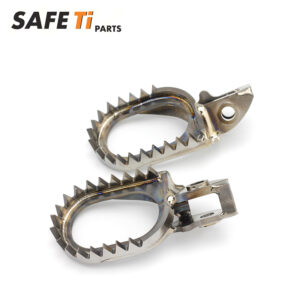
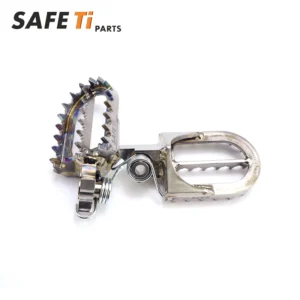

The Rider Triangle Matters More Than Most Riders Realize
One concept often overlooked by recreational riders is the rider triangle.
The rider triangle consists of three points:
- Handlebars
- Seat
- Footpegs
Together, they determine how your body fits the motorcycle.
Most riders immediately think about handlebars.
Some think about seat height.
Few think about footpegs.
Yet changing footpeg position can dramatically alter how the entire motorcycle feels.
For taller riders, even small changes in peg placement can transform overall comfort and control. Understanding the ideal footpeg position is often the first step toward building a more comfortable rider triangle.
Related: Best Footpeg Position for Tall Riders
A small adjustment at the pegs affects:
- Knee angle
- Hip angle
- Standing posture
- Weight transfer
- Rider comfort
This is why footpegs play such a significant role in long-term riding comfort.
Why Lower Footpegs Are Becoming Popular Among Tall Riders
Many tall riders discover that lowering the footpegs by just 5mm or 10mm creates a noticeable improvement.
The reason is simple.
Lower footpegs increase the distance between the seat and the pegs.
That extra room allows the legs to relax.
The knees remain at a more natural angle.
Standing feels less restrictive.
Transitions between sitting and standing become smoother.
Most importantly, the rider spends less energy simply maintaining position.
The motorcycle starts fitting the rider rather than forcing the rider to adapt to the motorcycle.
Is a 5mm Drop Really Noticeable?
This is one of the most common questions riders ask.
On paper, 5mm doesn’t sound like much.
On the bike, it often feels larger than expected.
The reason is that ergonomics are highly sensitive.
A small change in footpeg height affects multiple joints simultaneously.
The knees open slightly.
The hips gain additional freedom.
The standing position feels less compressed.
Many riders are surprised by how noticeable even a modest drop can be during a full day of riding.
Why More Riders Are Choosing Offset Footpegs
For some riders, lowering the footpegs isn’t the entire solution.
This is where offset footpegs become interesting.
Instead of only moving the peg downward, offset footpegs can move it:
- Downward
- Rearward
- Or both
Popular configurations include:
- 5mm Back + 5mm Down
- 5mm Back + 10mm Down
For taller riders, a slight rearward offset often creates additional legroom while maintaining natural body positioning.
The goal isn’t to radically change the motorcycle.
The goal is to make the rider triangle work more efficiently.
How Do You Know If Footpeg Position Is the Problem?
Many riders ask:
“How can I tell if my fatigue is caused by ergonomics rather than fitness?”
There are several common signs.
You may benefit from lower footpegs or offset footpegs if:
- Your knees feel cramped when seated.
- Standing feels uncomfortable after short periods.
- You struggle to move rearward on the bike.
- Your legs become tired long before your cardiovascular endurance does.
- You feel noticeably better on larger motorcycles than on smaller ones.
These symptoms often point toward a fitment issue rather than a conditioning issue.
Comfort and Performance Are More Connected Than You Think
There’s a common misconception in the riding world that comfort and performance are opposites.
They’re not.
The best-performing riders are often the most comfortable riders.
Why?
Because comfort reduces unnecessary effort.
When your body is relaxed:
- You react faster.
- You move more naturally.
- You maintain better balance.
- You ride longer before fatigue appears.
This is one reason factory race teams spend enormous effort optimizing rider ergonomics.
Even elite athletes benefit from a motorcycle that fits properly.
The Upgrade Many Riders Wish They Had Made Earlier
Ask riders who have switched to lower footpegs or offset footpegs and you’ll hear a recurring theme.
Very few describe the upgrade as dramatic.
Instead, they say things like:
“The bike finally felt right.”
“Standing became easier.”
“My legs didn’t fatigue as quickly.”
“I should have done this years ago.”
Those comments reveal something important.
The best ergonomic upgrades aren’t always the ones you notice immediately.
They’re the ones you stop thinking about because the motorcycle simply feels natural.
Final Thoughts
If you’re a tall rider who gets tired quickly while standing, don’t automatically blame fitness.
Strength matters.
Conditioning matters.
But ergonomics matter too.
A cramped riding position forces your body to work harder than necessary.
Over time, that extra effort becomes fatigue.
And fatigue eventually affects both comfort and control.
Lower footpegs and offset footpegs won’t make you faster overnight.
But they can make standing more natural, improve mobility, reduce unnecessary strain, and help your motorcycle fit your body more effectively.
Because sometimes the problem isn’t the rider.
Sometimes the motorcycle simply needs to fit the rider a little better.

